Turkey’s troop deployment in Iraq: new challenge to regional security
Thứ Năm, 10/12/2015
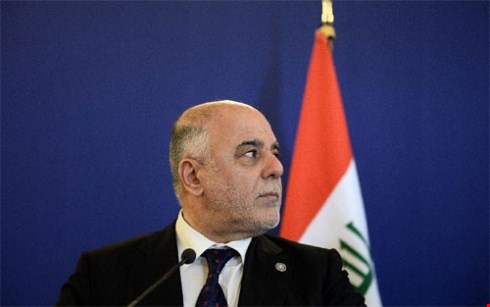
President of Iraq Haider al-Abadi (Source: AFP)
Many Turkish soldiers illegally
entered
Iraq
on December 4 to train Kurdish militias fighting IS. This has harmed relations
between
Iraq and
Turkey and created a new security challenge in
the
Middle East. International media
reported that 130-150 Turkish soldiers backed by armored vehicles approached
the Iraqi city of
Mosul without
Baghdad’s approval.
Turkey’s Sabah newspaper said
Turkey has approximately 1,200 ground troops,
500 engineers, and many tanks, armored vehicles, and artillery near
Mosul. Since 2014
Turkey has operated a training camp for Kurdish
fighters near
Mosul and two more in Soran and
Qalacholan in the autonomous Kurdistan region of northern
Iraq.
Tensions in bilateral ties
Turkish officials said the troop deployment on December
4 was routine. Approximately 2,000 volunteers from
Mosul
have been trained in Turkish training camps in
Iraq to fight IS. This training
program was carried out at the request of the government of
Mosul
in coordination with
Iraq’s
Defense Ministry. But representative of the Patriotic Union of Kurdistan (PUK)
Saadi Ahmed Pira said: “There are no agreements with
Turkey about military bases in
Iraqi Kurdistan. The only accord was concluded with the international coalition
of 62 countries, which includes
Turkey,
but it does not provide for the existence of military bases, only the training
of Kurdish forces fighting terrorism and air support”.
The Iraqi government has rejected
Turkey’s
explanation. On December 6,
Iraq
said it will appeal to the UN if
Turkey
does not withdraw its troops from northern
Iraq within 48 hours. A number of
members of Parliament asked the Iraqi parliament to convene an emergency
meeting to approve tougher military actions against
Turkey. President of the Iraqi
Parliament’s National Security and Defense Committee Hakim al-Zamili urged the
government to conduct airstrikes on locations occupied by Turkish soldiers to
retaliate for what he calls a serious violation of
Iraq’s sovereignty. Faced with
Iraq’s angry reaction Turkish Prime Minister
Ahmet Davutoglu said
Turkey
will halt its troop deployment in
Iraq but did not mention any troop
withdrawal. He also dismissed the allegation that
Turkey
is preparing for a military operation in
Iraq. On December 8 the UN Security
Council convened a closed-door meeting to discuss the incident.
Security risks for the
Middle
East
As a Sunni majority country
Turkey has closer relations with Kurdish forces
in
Iraq, which are led by
politician Massoud Barzani than the Shiite-controlled central government in
Baghdad. Analysts
describe
Turkey’s
troop deployment as a new Turkish diplomatic strategy.
Ankara’s
recent tough attitude demonstrates its ambition to control the situation in the
Middle East. Therefore
Turkey needs to
make the most of terrorist groups or any opportunity to topple the Syrian
government. Analysts say
Ankara has joined
Western forces to attack
Libya
and has deployed troops to
Iraq
and
Syria.
Head of the
Tigris
Communal
Research
Center in Turkey Mehmet Kaya said
Turkey sending more troops to Bashiqa near
Mosul is an attempt to widen differences between the
autonomous Kurdistan region and the central government in
Iraq and increase
Turkey’s position in the region.
Aaron Stein, a Nonresident Senior Fellow at the Atlantic Council's
Rafik
Hariri
Center for the Middle East, said this
is part of an attempt by
Turkey
to annex the Kurdish-controlled region in
Iraq.Troop deployment to
Iraq
is a risky step considering that tensions over
Turkey’s downing of a Russian jet
have not yet eased. It has further complicated the situation in the
Middle East